
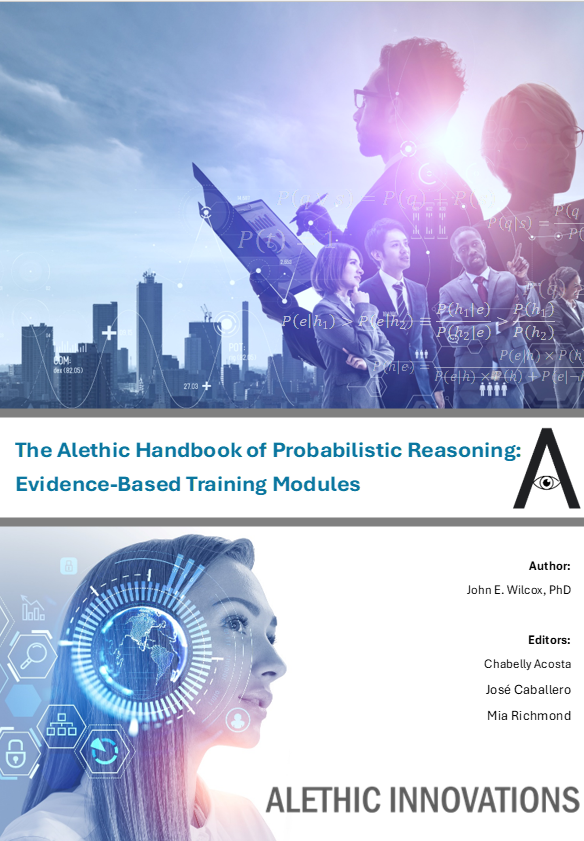
Review of '“The Alethic Handbook of Probabilistic Reasoning”
by Professor Jan Sprenger, Author of Bayesian Philosophy of Science (with Stephan Hartmann, Oxford: Oxford University Press, 2019)
December 26, 2025
“Many books on uncertain reasoning begin by explaining a particular paradigm, usually frequentist or Bayesian statistics, and then proceed to specific techniques inside that paradigm. This book pursues a different and unique approach: it aims at training the readers’ sense for probabilistic reasoning and at lowering their tendency to make reasoning fallacies. It gives them a feeling for the probability calculus, explains basic statistical concepts such as the reference class and degrees of confirmation, and points them to errors they have to avoid. It is rich in real-world examples and exercises that test whether the reader has really understood the material. All these features make it a timely and unconventional book on how to handle uncertainty. Medical doctors, lawyers, judges, CEOs and policy-makers will enjoy it and it will help them to make better decisions in their daily life.
Most books start with an axiomatic introduction of the probability calculus. This is rather high-level for a large part of the intended readership. Apart from a brief introduction on the concepts of conditional and unconditional probability, the first two chapters of this book focus on making resolute probability estimates, and on calibrating them with real-life frequencies or tendencies. These questions are rarely tackled in the philosophical and scientific literature on statistical reasoning, but evidently practitioners do care about them. In the subsequent chapters, the more theoretical concepts of statistical reasoning, like Bayes’ Theorem and the likelihood ratio, are presented as providing answers to these basic questions, connecting the mathematical apparatus with the practical questions that motivated its development.
Specifically, the third chapter gives a brief introduction to probability calculus, keeping technicalities at a minimum (there is a more detailed appendix, though), and the fourth and fifth chapter explain how we can determine the degree of evidential support of a hypothesis. These chapters are mainly based on Bayesian statistics and Bayesian confirmation theory (=the more philosophically minded counterpart of Bayesian statistics). They contain useful case studies on how to combine prior probabilities and likelihoods, what consilient evidence consists in, and how we learn from multiple pieces of evidence. At times, the level of mathematical sophistication may exceed the reader’s horizon, especially in the part about consilience, but nonetheless, these parts are useful to illustrate different confirmatory strategies (in particular, prediction vs. accommodation of evidence).
Chapters 6–8 go beyond traditional statistical topics and deal with questions such as the use of heuristics, the recognition and evaluation of experts, and strategies for collecting and selecting evidence. These are topics at the intersection of (social) epistemology, a branch of philosophy, and cognitive science.
The book concludes with an assessment module focused on applying the concepts and techniques of the book in practice. It contains three appendices: Appendix A is a useful glossary of terms, Appendix B is for readers who want to understand the mathematics of probability more profoundly and Appendix C introduces the reader to issues in debates between Bayesian and frequentist approaches to probability.
All in all, this is a timely, engaging and well-informed book which will hopefully find a lot of readers and help them to make better decisions.”